

Leaflet Details
| Title | Carbohydrate Counting |
| Department | Diabetes / Dietetics |
| Author(s) | Julie Fleming |
| Review Date | December 2023 |
| Next Review | December 2025 |
| Download | A5 Booklet PDF |
| Accessibility Options | Click on the Recite Me button to show our accessibility resources |
Patient Information
What is carbohydrate counting?
Carbohydrate counting involves matching bolus insulin to how much carbohydrate is consumed in food / drink. It can help improve blood glucose control. It allows you to eat a variety of foods at times that are convenient for you rather than set mealtimes.
It can give you more freedom and flexibility in what you eat when you're preparing meals at home, grabbing food on the go or eating out.
Carb counting does take some time and effort to learn, but the control that comes with it can make life much easier. Whether you've been doing it for a few months or a few years, it always helps to refresh your knowledge from time to time.
What are carbohydrates?
Carbohydrate is a nutrient and source of energy found in foods such as potatoes, rice, pasta, cereals, milk, fruit, sweets and sugary drinks. Different foods contain different types of carbohydrate.
- Starchy: potatoes, sweet potatoes, squashes, rice, pasta, noodles, bread, cereals, quinoa, couscous, chapattis, bulgar wheat, crackers, and pulses. It is also in products made from flour, foods coated with breadcrumbs or batter. Check the food labels of processed meats, such as sausages and burgers, as some might include flour or breadcrumbs.
- Fructose: fresh and dried fruit, fruit juice, fruit smoothies.
- Lactose: milk, yoghurt, ice cream, custard, fromage frais, milkshake, milk puddings.
- Foods containing added sugar: table sugar, syrup, honey, sweets, biscuits, cakes, muffins, cookies, chocolates, puddings and desserts, jams, and marmalades.
How can I carbohydrate count?
1. Carbs and Cals book or phone app – visual comparison
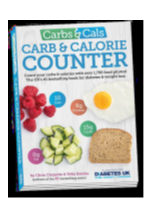
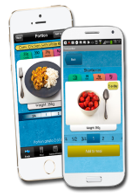
Images credited to Carbs & Cals
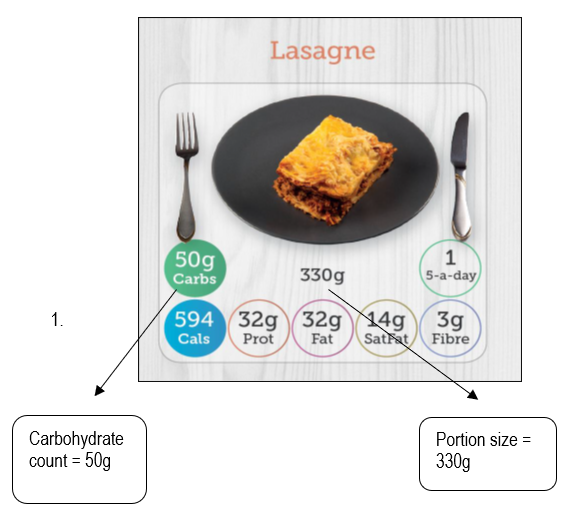
The book / app is a good resource for anyone who is carbohydrate counting or would like to learn the skill. It allows for a visual comparison between your intake and the pictures in the book/app, to help estimate your carbohydrate content of your meal. Please see the example below. (Image credited to Carbs & Cals)
2. Reading labels on food packaging
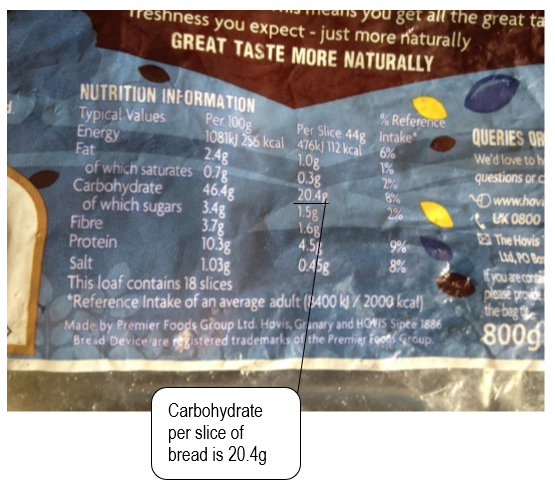
- Always look at the total amount of carbohydrates.
- Do NOT use the ‘of which sugars’ section.
Example: Bread
3. Food scales
- Weigh the food.
- Find the carbohydrate content of 100g of food from the food label.
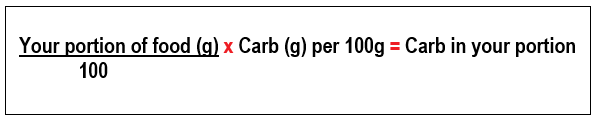
- Calculate the carbohydrate content of the portion using the equation below.
Example
You eat a 45g portion of sugar-free muesli at breakfast. You note from the food label that it has 57g of carbohydrate per 100g. The calculation, using the above equation would look like this:

Rice, Pasta, Potatoes
Foods such as rice and pasta absorb water when they are boiled and become heavier. The longer the cooking the more water is absorbed.It is recommended to cook your own portion of rice or pasta (having weighed the dry weight) for a set time and either weigh it again or measure it in cupfuls so that next time you know the carbohydrate of the cooked portion. Baked or roasted potatoes lose water when they are cooked as they dehydrate; therefore, their weight decreases (although the carbs stay the same).
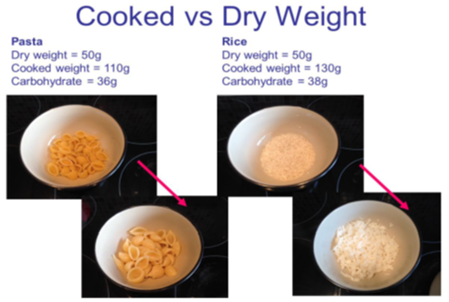
Image is credited to UCLH
Carb counting at home:
Using the Diabetes UK recipe pages can take the hard work out of calculating the carbohydrate content. But there's no need to throw out your favourite recipes and cookbooks. Taking the time to work out the carbohydrate values of your day-to-day meals can help build up a personal reference list that you can use again and again.
Three ways to start carbohydrate counting today
The first step to start carb counting is by finding out more information like:
- Do you know which of your food and drink contain carbohydrates? Stop, think, and make a mental note of which food and drink will need to be counted.
- Get label savvy - scrutinise the nutrition labels. Pull the food and drink out of your kitchen cupboards and find out just how much information you have to hand.
- Practise estimating the carbohydrate content of your meals - use reference lists to check your accuracy.
Useful websites:


