

Leaflet Details
| Title | Nasogastric Tube Feeding |
| Department | Dietetics |
| Author(s) | Dietetics |
| Review Date | October 2024 |
| Next Review | October 2026 |
| Download | A5 Booklet PDF |
| Accessibility Options | Click on the Recite Me button to show our accessibility resources |
Patient Information
What is a nasogastric (NG) tube?
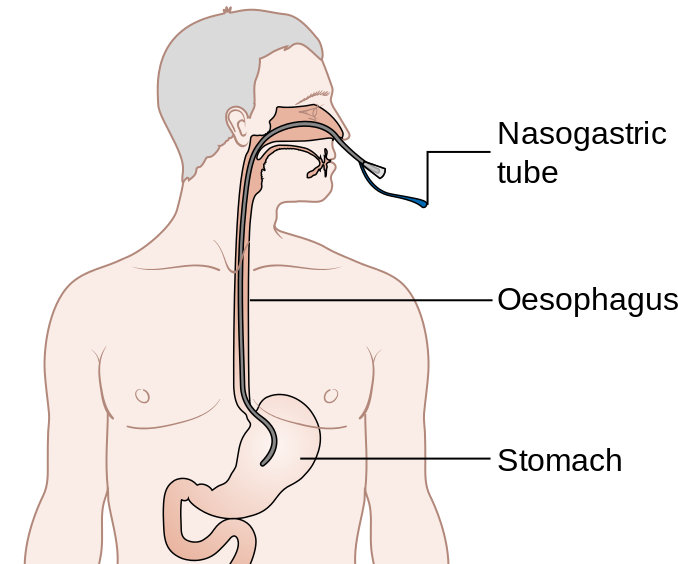
A nasogastric (NG) tube is a long, thin tube made from soft, flexible plastic. It is placed into your nose and passed down your food pipe (oesophagus) into your stomach (as shown below). It is commonly used for providing nutrition, fluids and medications.
Why do I need a nasogastric tube?
It may be unsafe for you to take food and fluids by mouth, or you may be unable to manage enough to remain well. An NG tube can be used to give you the liquid food, fluids and medications you need to help you through this period.
How is it placed?
A member of staff trained in inserting NG tubes will talk you through the procedure and ask if you agree to it. This will give you an opportunity to ask any questions you may have. If you are unable to make the decision for yourself at the time, the medical team may decide based on your best interests.
You will be asked to sit in a position you are comfortable in. This may be sitting in a chair or in your bed. The tip of the tube will be lubricated, passed up one of your nostrils, down your food pipe (oesophagus) and into your stomach. If it is safe to do so, you will be asked to drink throughout, to help the tube be passed more easily. Once the tube is inserted, it will be taped to your nose and/or cheek to prevent it moving.
Having the tube passed may be uncomfortable but should not be painful. The discomfort should be temporary. It may make your nose run or make you sneeze.
What if the tube cannot be inserted on the ward?
If this happens, you may need to go to another department where trained staff will use a camera or x-ray machine to help to insert the tube. This simple procedure will be explained to you in more detail before the NG tube is passed.
How long will I need the tube for?
An NG tube is not usually recommended for long-term use. You will need it until you are safely able to eat and drink sufficient amounts, or you may have it replaced with a longer-term tube. Your multi-disciplinary team (MDT) will discuss this with you if required.
Will I still be able to eat with an NG tube?
Your Speech and Language Therapist will assess if you are safe to eat and drink, or if you need to remain “Nil By Mouth” (NBM). If your team advise that it is safe for you to eat and drink, you can continue to do so with an NG tube in place.
How will I take medication?
Most medications are available in liquid form and can go down the NG tube. If liquid versions of medications are not available, tablets may need to be crushed, mixed with water and then syringed down the NG tube. Your pharmacist will be able to advise on this.
What and how will I be fed?
Liquid food will be given through your NG tube. The liquid food comes in pre-packed bags and contains protein, energy, vitamins and minerals. Your dietitian will advise on the type and amount of liquid food needed and discuss feeding plan options with you.
The liquid food is usually delivered through a pump device that is connected to the NG tube and delivers the food continuously over several hours. Occasionally, it may be delivered as larger volumes (boluses) a few times over the day using a syringe connected to the NG tube.
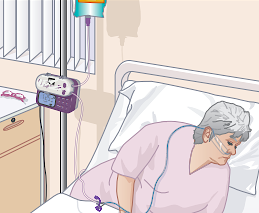
Continuous administration (Pump)
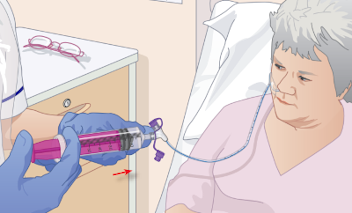
Bolus administration (Syringe)
What are the benefits and risks of NG tube feeding?
The benefit of having an NG tube placed is that all your nutrition, fluid and medication needs can be met, either totally, if you cannot eat at all or in addition to any food you are managing.
The main risk associated with NG tube feeding is the risk of liquid food accidentally going into the lungs, which can cause infection (aspiration pneumonia).
It is important that the position of the NG tube is checked every time before being used as there is the potential for the internal end of the NG tube to become displaced without any obvious visual signs.
For this reason, if you experience any vomiting, retching, unexplained breathing problems or the tape securing your NG tube becomes loose then please inform a member of the healthcare team immediately so that they can check the position of the NG tube.
How is the position of an NG tube checked?
This is done by withdrawing a small amount of stomach fluid into a syringe (aspirated) and checking this using pH paper. If the fluid drawn up (the aspirate) is acidic then it indicates the tube is in your stomach.
If for any reason, there is no aspirate or if it is not acidic then you may be sent for a chest x-ray to confirm the NG tube is in the correct position.
If I am not eating, how do I look after my mouth?
Plaque and bacteria can build up in your mouth, even if you are not eating, so it is important that it is kept clean by brushing your teeth and tongue regularly. Nursing staff or Speech and Language Therapists can advise you further.
What are the alternatives to NG feeding?
If your gastro-intestinal tract (gut) is working but you cannot take any or enough nutrition orally, then using a feeding tube such as an NG tube is the only short-term option to get your full nutrition.
If you do not want to have a NG tube but are unable to eat enough by mouth it is likely that you will become dehydrated and malnourished which both have significant health risks.
Eating and drinking with acknowledged risks refers to a decision to continue eating and drinking despite the potential associated risks of aspiration, malnutrition, dehydration and choking. Please speak to a member of staff if you would like to discuss this option further.
This leaflet was produced by the Department of Nutrition and Dietetics of Ashford and St. Peter's Hospitals NHS Trust. If you would like any advice, please contact the Department on 01932 722202.


