

Leaflet Details
| Title | Pelvic Health and Diarrhoea |
| Department | Dietetics |
| Author(s) | Dietitians |
| Review Date | October 2025 |
| Next Review | October 2027 |
| Download | A5 Booklet PDF |
| Accessibility Options | Click on the Recite Me button to show our accessibility resources |
Patient Information
What is the link between pelvic health and diarrhoea?
Long-term diarrhoea can cause pelvic floor dysfunctions. The pelvic floor consists of muscles that help control defecation. A successful bowel movement requires the coordination of gentle deep abdominal muscle contractions with simultaneous full relaxation of the pelvic floor. People who have long-term diarrhoea might experience bowel urgency and/or incontinence of loose stools.
Difference between diarrhoea and faecal incontinence
It is important to distinguish between diarrhoea and faecal incontinence (difficulty controlling your bowels).
- Diarrhoea is defined as the passage of 3 or more loose or liquid stools per day, or more frequently than is normal for the individual.
- Faecal incontinence is the involuntary loss of stool which can occur if your pelvic floor muscles lack strength, endurance, and functional control.
Both can be very upsetting and embarrassing, but it is important to seek medical advice. Physiotherapists with specific training in pelvic health offer treatments that can help improve your faecal incontinence.
Diarrhoea can be experienced short or long term. The most common cause of short-term diarrhoea is gastroenteritis, a bowel infection caused by a virus (norovirus or rotavirus), bacteria (campylobacter and Escherichia coli) or a parasite (Giardia intestinalis). This form of diarrhoea usually resolves within a week and does not require medical attention.
Long-term diarrhoea can have several triggers and investigations might be suggested by your GP, your consultant or another Health Care Professional to identify the cause.
Table 1: Conditions and factors which may cause or contribute to long-term diarrhoea
| Conditions | Factors |
|
|
What do your stools look like?
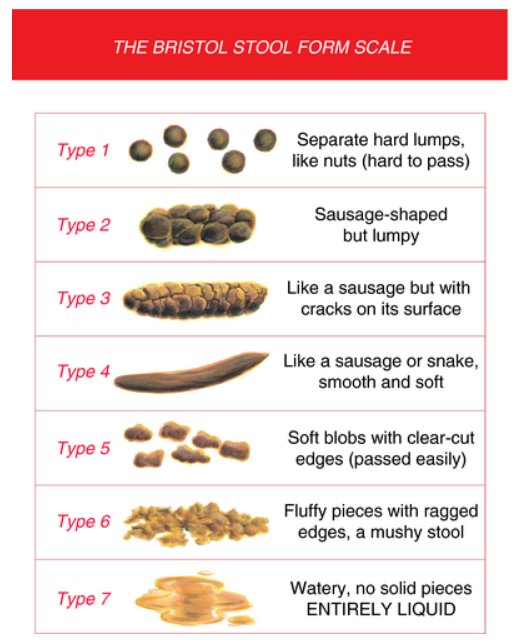
The Bristol Stool Form Scale below illustrates the types of stool a person may pass.
The consistency of stool depends on how long it has spent in the colon. The longer it spends ‘in transit’, the more liquid is absorbed by the colon.
- Types 1-2 indicate constipation
- Types 3-4 are well-formed stools and a sign of a healthy system
- Types 5-7 indicate diarrhoea.
Table 2: Bristol Stool Form Scale
© 2018 Rome Foundation, Inc. All Rights Reserved
Dietary changes which may improve diarrhoea
- Limit the intake of caffeinated drinks (tea, coffee and caffeinated soft drinks) to three drinks per day
- Limit alcohol intake to less than 14 units a week and ideally no more than two units per day. Have at least two alcohol free days a week
- Limit the intake of spicy, fried or very fatty foods (e.g. curries, chips, chocolate, creamy sauces, fatty meats, pastries, cheese)
- Limit the intake of fruit to three portions per day (one portion is 80g) and spread them out throughout the day
- If you feel your diet is high in fibre, try reducing the intake of high fibre foods such as wholemeal bread, wholegrain cereals, brown rice and pasta and foods made with wholemeal flour Remember nuts, seeds and dried fruit are also high in fibre
- Avoid sugar-free sweets, mints, gum and diet drinks containing artificial sweeteners such as sorbitol, mannitol and xylitol.
Please note: diarrhoea can cause dehydration so aim for 1.5 to 2 litres of fluid a day. This is the equivalent to around 6-8 mugs of fluid or 8-10 glasses of fluid per day. Good drinks to choose include water, sugar free squash, decaffeinated coffee or tea and herbal tea.
Diarrhoea and Probiotics
Probiotics contain beneficial bacteria intended to restore the equilibrium of the intestinal flora, or to preventing the flora getting out of balance. There are several types of probiotics on the market and there is enormous variability in the different products. There is some evidence of efficacy for these probiotic supplements: VSL#3, Bioflora, Alflorex, Biocare, Duolac and Symprove. Probiotics should be taken, at the dose recommended by the manufacturer, for at least 4 weeks while monitoring the effect.
When to seek support from your GP
You should see a doctor straight away if the diarrhoea is particularly frequent or severe, or associated with any of the following symptoms:
- Blood in your stools
- Bleeding from your rectum
- Persistent vomiting
- A severe or continuous stomach-ache
- Unintentional and unexplained weight loss
- Drowsiness, passing urine infrequently, and feeling lightheaded or dizzy - this might indicate dehydration
- Your stool is dark or black - this may indicate bleeding inside your stomach
- A family history of bowel or ovarian cancer
- A change in bowel habit to looser and / or more frequent stools persisting for more than six weeks if you are over 60.
You can ask to be referred to a Registered Dietitian when:
- You feel there are specific foods triggering your diarrhoea
- Despite making changes to your diet and lifestyle for at least 4 consecutive weeks, your bowel symptoms do not improve
- Your GP, your Consultant or another Health Care Professional feels that you would benefit from receiving tailored dietetic advice.
Dietetic Department at St Peter’s Hospital:
We run several dietetic clinics that advise people on managing diarrhoea including General Gastroenterology, Coeliac Disease and IBS Clinic. You will be offered an appointment in the one most appropriate for you.
At your appointment, a Registered Dietitian will ask you relevant information about your lifestyle and dietary habits and will discuss with you suitable treatment options.
If you would like more information about the Dietetic Department at St. Peter’s Hospital, please visit this website link:
https://www.ashfordstpeters.nhs.uk/dietetics
Useful Resources:


