

Leaflet Details
| Title | Grommets and Adenoidectomy |
| Department | Ear, Nose and Throat |
| Author(s) | Miss Pandora Hadfield |
| Review Date | September 2022 |
| Next Review | September 2024 |
| Download | A5 Booklet PDF |
| Accessibility Options | Click on the Recite Me button to show our accessibility resources |
Patient Information
Why does my child need grommets and adenoidectomy?
Grommets are used to treat Glue Ear and help your child’s hearing. Adenoidectomy prolongs the benefit from Grommets and may also help with snoring and nasal blockage.
What is Glue Ear?
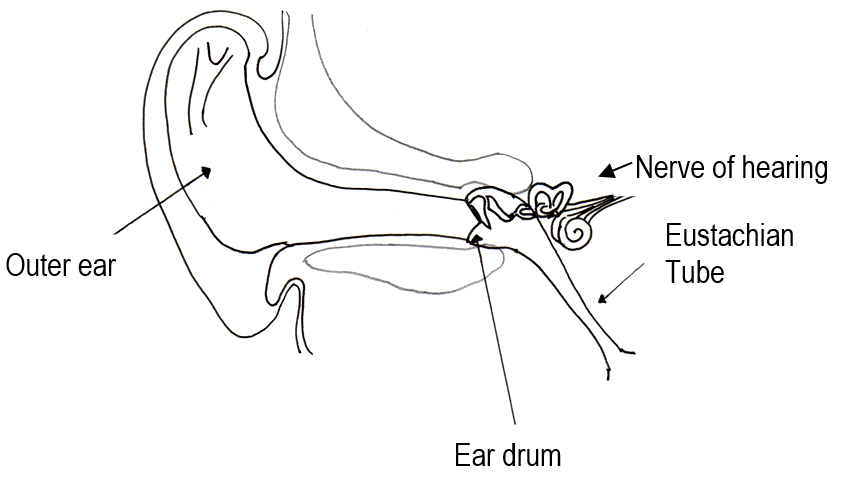
In this condition the air behind the ear drum (in the middle ear) is replaced by “glue” or thick mucus. This muffles the incoming sound and causes a hearing loss. The Eustachian tube usually allows air to pass freely between the back of the nose and middle ear, this is necessary for the ear to function and hear well. In children this tube can become blocked at the lower end by enlarged adenoids, leading to Glue Ear. Children under seven years old are particularly prone to this.
What will happen in the operation?
During the procedure (when your child will be fully asleep under a general anaesthetic) the glue is removed. This improves hearing and in order to prevent the glue re-accumulating a small Teflon tube, or grommet, is inserted into the eardrum to allow air into the middle ear. At the same time the adenoids are examined, via the mouth, and if they are enlarged, they are removed to unblock the lower end of the Eustachian tube.
How will my child feel after the operation?
Most children can hear better immediately, in fact some loud noises may sound a little overwhelming at first, but your child will soon become used to them. Discomfort is rarely a problem but paracetamol (Calpol) or non-steroidal painkiller syrup (e.g., ibuprofen / Nurofen) can be used. Your child will feel well and able to eat soon after the operation and can go home a few hours later. If they have had an adenoidectomy, they should avoid mixing with other people for a few days afterwards and stay off school for 5-7 days in order to avoid any infections.
Are there any risks?
The ears may discharge mucus or bleed slightly, but this should settle down quickly. The Ear, Nose and Throat (ENT) surgeon may prescribe antibiotic ear drops or syrup. After adenoidectomy you may notice a slight odour from the nose for a few days, this is normal, and the antibiotic syrup will help.
If the adenoids are removed, they may leave a small gap between the palate and the back of the throat; sometimes it takes a few days for the muscles of the palate to adjust to this. It is possible that for the first few days fluids can be regurgitated back and out through the nose during swallowing, this is very rare however and if it does occur is likely to settle down without further treatment.
Bleeding is very unlikely after adenoidectomy but if you are concerned, please phone the ward or in an emergency go to the A&E department at the Royal Surrey County Hospital.
Grommets usually fall out between 12-18 months, when the ear no longer needs them. This is not usually noticed but will be confirmed when your child is examined by a doctor during a follow-up appointment. When the grommets fall out, they leave a small hole in the ear drum which heals naturally within a few days. Very occasionally the hole does not close, leaving a permanent perforation of the ear drum. If this is troublesome it may need an operation to close it when your child is slightly older. The chance of a perforation is small, but the likelihood is increased if the grommet has become infected. It is therefore important to reduce the chance of infection while the grommet is in place by using ear plugs in the bath or shower and when swimming, to prevent water entering the grommet. These are available from pharmacy shops and online. If you notice any yellow, brown, or green discharge from the ear (other than wax) this indicates the grommet may be infected and should be treated with antibiotic eardrops (antibiotics by mouth are not effective) which can be prescribed by your GP or the ENT clinic.
Any further worries?
If you are concerned after the procedure, these please consult your GP, the ward where your child was admitted or in an emergency the A&E department at the Royal Surrey County Hospital, Guildford, where we have on call ENT staff 24 hours a day.
- Oak Ward, St. Peter’s Hospital: 01932 722712
- Royal Surrey County Hospital: 01483 571122
Further information:
https://www.entuk.org/patients/conditions/5/grommets
Consultants and Specialists
- Mr Sam Cartwright, Consultant ENT Surgeon
- Mr Andrew Cruise, Consultant ENT Surgeon
- Mr Stephen Derbyshire, Consultant ENT Surgeon
- Miss Pandora Hadfield, Consultant ENT Surgeon
- Dr Tatiana Gutierrez, Speciality Doctor ENT.


