

Leaflet Details
| Title | Endoscopic Retrograde Cholangio-Pancreatography (ERCP) |
| Department | Endoscopy Unit |
| Author(s) | Jean Asare |
| Review Date | June 2023 |
| Next Review | June 2025 |
| Download | A5 Booklet PDF and A4 Handout PDF |
| Accessibility Options | Click on the Recite Me button to show our accessibility resources |
Patient Information
Introduction
This information leaflet contains information about your procedure including the risks, benefits, alternatives to the test and what you might expect when you come to the hospital. If, after you have read it, you have any queries or concerns, please talk to us about any worries and ask any questions you may have.
The aim of this booklet is to enable you to make an informed decision when you come for your procedure. It is important to us that you have understood the procedure, its risks, and benefits before we ask you to sign your consent form. We will need to have your formal written consent before we can perform your procedure which will be done by your Endoscopist.
Your appointment time in the Endoscopy Unit is approximate, as some procedures may take longer than expected. We also deal with emergencies, and these can take priority over patients with outpatient appointments. You should expect to be in the department approximately for most of the morning and / or afternoon.
Preparation for the procedure
Eating and Drinking
You must not eat anything for at least six hours before your procedure because the food in your stomach can prevent the Endoscopist from having a good view of your stomach. It can also increase the risk of inhaling the contents of your stomach into your lungs which can cause severe pneumonia.
You can have a few sips of water up to two hours before your test.
Medicines
Unless you have been advised otherwise, you should take your usual medicine normally with a few sips of water.
If you have diabetes, either on tablet or Insulin, please telephone us on 01932 722231 / 01932 722747 for advice at least one week before your endoscopy appointment.
If you are on any blood thinning medication like Warfarin, Dabigatran, Edoxaban, Apixaban, Rivaroxaban or anti platelet medication like Clopidogrel, Prasugrel and Ticagrelor, please inform us as soon as possible as it may be necessary for you to stop taking your tablets for a limited time before the procedure.
As you will be given sedation for this procedure, you will not be permitted to drive home or take public transport; you must arrange for a family member or a friend to collect you from the Endoscopy Unit.
You must have an adult to stay with you overnight. The doctor may need to do some complex interventions during the procedure which may increase the risk of you getting complication. For this reason, you must have a responsible adult to stay with you overnight. Please note that your procedure will be cancelled if you have not made this arrangement.
What is an ERCP?
Endoscopic Retrograde Cholangio- Pancreatography (ERCP) is an examination that is performed using both endoscopy (a flexible telescope to look inside your gut) and X-Ray. It is used mainly to diagnose and treat conditions which affect the bile duct which is the part of your body that drains your bile from the liver into your small bowel. Sometimes the pancreatic duct, which drains digestive juices from the pancreas into the small bowel, is also examined.
During the procedure, a flexible tube called a duodenoscope is passed through the mouth into the gullet, stomach, and small bowel. This tube has a light and a camera at the end which feeds the images into a monitor where it can be viewed by the Endoscopist.
Cholangio-Pancreatography means x-ray pictures of the bile and pancreatic ducts. These ducts do not show up very well on ordinary x-ray pictures, but if a contrast dye is injected into these ducts, then x-ray pictures will show up these ducts clearly. Dye is injected into the bile duct or pancreatic duct (a 'retrograde' injection) using a plastic tube via the duodenoscope and x-ray pictures are taken.
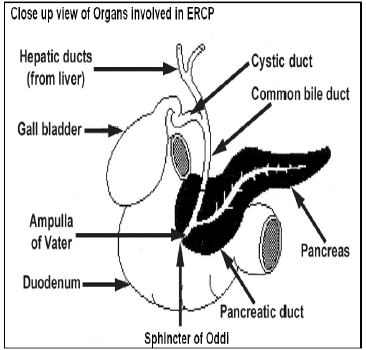
During your ERCP, a small cut at the bottom of your bile duct is often made, this is called sphincterotomy. This is usually done to allow your doctor to place instruments and carry out interventions like removing stones and stenting strictures. This cut is performed by using a diathermy machine.
The examination is carried out by a trained doctor Endoscopist. Sometimes, however, the test may be carried out by an Endoscopist who is learning, under the close supervision of the experienced Endoscopist.
To help you during the procedure, you will be given the following medication before your examination is carried out:
Anaesthetic throat spray - A local anaesthetic spray is given at the back of your throat – this has an effect very much like a dental injection. This medicine will numb your throat allowing the duodenoscope to go down with ease.
Sedation via a needle - A sedative injection can help you relax during the examination. It can sometimes make you drowsy which can help you tolerate the procedure. A sedative is different to general anaesthetic, its purpose is to help you relax and not ‘knock you out.’
Pain relief via a needle - The procedure is not painful but can be uncomfortable especially when we put air into your small bowel. A pain relief injection will help you tolerate the procedure.
Because the sedation and the pain relief can cause drowsiness, you will not be permitted to drive home or take public transport. You must arrange for a family member or a friend to collect you from the Endoscopy Unit and you must have an adult to stay with you overnight.
There is a considerable variation in the way people react to this procedure and the sedation. The procedure is safe but may be unpleasant and at times uncomfortable. We aim to use the sedation to help you relax within safe limits. We do NOT aim to send you to sleep but we will do our best to make the procedure as comfortable as possible.
Antispasmodic via a needle - A medicine called Buscopan can be given to relax your small bowel during the procedure; this will enable the doctor to perform the procedure safer. Please let us know when you come to the department if you suffer from a condition called glaucoma or if you suffer from any heart disease.
Intravenous Antibiotics - antibiotics can be given to you before the start of your procedure as a prophylaxis to help prevent procedure-related infection. Your doctor on the day will decide whether an antibiotic is necessary, and the type of antibiotics will depend on if you have any allergies to specific antibiotics.
Suppository - a medicine called Voltarol can be given to you before the start of the procedure. It comes as a suppository form which will be given to you via the back passage. This type of medicine can help prevent a complication called pancreatitis which will be explained separately in this booklet.
Why do I need an ERCP?
An ERCP will allow your doctor to gain detailed information about your common bile duct and / or pancreatic duct. It is also done to achieve the following treatment:
- Remove stones from the bile duct.
- Treat jaundice (yellowing of the skin or eyes) caused by gallstones or narrowing in your bile ducts by clearing a blockage of the bile flow.
- Insert a plastic tube or a metal tube to drain bile or pancreatic juice.
- Take biopsies or brushing samples from the bile duct or the pancreatic duct.
Are there any alternatives?
- Magnetic Resonance Imaging (MRI) scan can be performed but this investigation does not allow direct vision of the bile ducts and will not allow interventions as it is only a diagnostic test. Also, you cannot have an MRI scan if you have some internal metal works in your body like pacemaker and metal screws following a joint replacement surgery.
- Computerised Tomographic (CT) scan can also be performed although this investigation is less sensitive. Any lesions less than 1cm can be missed, and this procedure will not allow us to take biopsies or do any treatments.
- An Endoscopic Ultrasound (EUS) can provide a really good image of the biliary system and your pancreatic duct, but biopsies cannot be taken, and treatments cannot be performed.
Although ERCP carries some risks, this procedure will help your doctor get a diagnosis and / or provide you with the necessary treatment. Your doctor will carefully assess the risks and weigh them to see how much you can benefit from this procedure. Your doctor will be very happy to discuss this with you when you come for your appointment.
What can happen if I do not want to have treatment during this procedure?
If the blockage in the common bile duct, from either stones or strictures, was not treated you would become very ill, and this can be life threatening.
What are the possible risks and complications of ERCP?
ERCP is a safe examination for most people and serious complications are uncommon. The Endoscopy team is trained to detect and treat any complications that may happen. The possible risks are listed below:
- A tear (perforation) may occur in the duodenum (small bowel) either because of a damage caused by the duodenoscope or sphincterotomy; this happens in less than 1 in 750 cases. Should this happen, we will arrange for you to stay in hospital to have the right treatment which may mean an operation.
- Bleeding can occur in 1 in 500 people, but the risk is higher (10 in 500 cases) if sphincterotomy was done. The bleeding usually settles on its own, but if required, your doctor can inject a medicine called Adrenaline on the bleeding site through the duodenoscope. However, in severe cases, blood transfusion, a special x-ray procedure or a surgery can be performed.
- Mild inflammation of the pancreas (pancreatitis) can affect 1 in 20 people. This can cause abdominal pain which usually starts few hours after the procedure and can last for few days. It can be a severe complication which may mean you need to stay in the hospital for several days so correct treatment can be given to you.
- Breathing difficulty or heart irregularities because of reaction to the sedation or accidentally inhaling secretions such as saliva during the procedure. We will monitor you continuously during the procedure so if any of these problems occur, we would be able to treat it quickly.
- Damage to teeth or bridgework - this is rare. The endoscopy nurse will place a plastic mouthpiece in your mouth to help protect your teeth.
- Adverse reaction from the contrast or dye we use for the procedure.
- Mild discomfort in the abdomen and sore throat which can last up to a few days.
What will happen when I come in?
When you come to the Department, please present yourself at the reception where they will confirm your details with you. Please note that we have a limited amount of space in the Department and there may not be an available space for a friend or relative to accompany you during your appointment.
A member of staff will bring you in the Admissions area to go through your health questionnaire with you. They will record your blood pressure, heart rate, and temperature.
An intravenous cannula will be placed in your arm / hand; this will be used as an access so the Endoscopist can give you the sedation, pain relief and other injectable medication before the start of the procedure. Your admission nurse will make sure that the procedure is thoroughly explained and that you understand the procedure before you sign your consent form. This will be an opportunity for you to ask any questions you may have. The member of staff will also ask you about your arrangements for getting home after your procedure. Because of the sedation and pain relief that will be given to you before the start of your procedure and the complexities of the treatments that might be performed during your procedure, a responsible adult must be available to take you home and stay with you overnight.
Please note that your procedure will be cancelled if you have not made these arrangements.
You will be asked to change into a hospital gown. You will also need to remove your jewellery and any metal piercings as this can interfere with the x-ray image or when using the diathermy machine.
We will be asking you to sign your consent before you can be taken into the procedure room where your endoscopy will be performed.
What happens during the ERCP examination?
Your procedure will be carried out in one of the examination rooms in the Endoscopy Department where experienced members of the team will be always with you.
Before we start the procedure, you will be given a local anaesthetic throat spray whilst you are sitting up (if you have any dentures, you will be asked to remove them first), the results are rapid, and you will immediately experience loss of sensation at the back of your throat. A member of staff will put a blood pressure cuff on your arm, three electrode stickers on your back to check your heartbeat and a probe will be placed on your finger to check your oxygen level throughout the procedure. We will also place a plastic cannula into your nostrils to supplement your oxygen during the procedure. You will be asked to lie on your stomach and a suppository medicine will be given into your back passage. Your antibiotics, sedation and pain relief will be given at this point.
A small plastic mouth guard will be placed gently between your teeth to help you keep your mouth slightly open and make it easier for the Endoscopist to pass the endoscope (camera), which is no bigger than the tip of your finger.
The Endoscopist will start the test by placing the lubricated endoscope into your mouth. The Endoscopist will then push the duodenoscope gently down into your oesophagus, stomach and duodenum, a small amount of air is blown into your stomach, this is necessary to allow the Endoscopist to have a clear view during the procedure.
During the procedure, your Endoscopist will push a fine wire into the bile ducts and will inject some contrast or dye. This will enable him to view x-ray images of your biliary system and plan appropriate treatments as required.
If the x-ray image shows that you have stones in the gall bladder, your doctor will make a small opening of your bile duct (sphincterotomy) by using an electrically heated wire. This procedure is safe, and you will not feel anything whilst this is being done. After this, your doctor will be able to remove the stone(s) by using a balloon to pull it down into your small bowel or a special basket to catch it and crush it. It may be necessary to leave a plastic tube (stent) to allow drainage of your bile if not all the stones have come out, your doctor will you after the procedure if this was done.
If the x-ray image shows some narrowing (stricture), your doctor will be taking some cell samples or biopsy. After this, a plastic tube (stent) will be placed to go above this narrowing; this is usually a temporary measure to allow your bile to drain. If necessary, your doctor may decide to put a metal stent in instead and this may remain in place permanently. There is a chance that your stent can be blocked so a repeat ERCP may be necessary to replace it.
Photographs may be taken during your procedure; these will be filed and kept in your medical notes.
The length of the procedure varies depending on what therapeutic procedure is required. When the examination is finished, the duodenoscope will be removed carefully.
What happens after an ERCP?
After your procedure, you will be taken back into the Endoscopy Unit where you will be kept in the recovery area for at least four hours. During this period, a member of staff will monitor your blood pressure, pulse, temperature, and oxygen saturations regularly. If you are diabetic, we will be monitoring your blood sugar levels until you are allowed to eat and drink.
We will be offering you tea / coffee and biscuits as refreshments, if you feel that this not sufficient, you may want to bring your own.
You should be able to normally eat two hours after the procedure is done. However, depending on the type of treatment you had during your ERCP, we may need to delay this. The nurses in the recovery area will be able to advise you if this would be necessary.
You should continue to take your usual medication unless we tell you otherwise. If you are taking any blood thinning medication, we will be giving you an advice when to restart it before we send you home.
The plastic cannula used to give you the sedation will also be removed.
The sedative can make you forgetful and can make you feel intermittently tired and drowsy for at least 24 hours; your doctor has also performed a complex procedure where risks are much higher, this is why we strongly recommend that you arrange someone to stay with you overnight.
For 24 hours following your sedation, you must not drive, drink alcohol, operate any heavy machinery or sign any legal document.
When you are ready to be collected, a member of staff will telephone your escort when you are ready to go home. Once your escort has arrived, you will be taken to a private room where a member of staff will go through all your discharge information with you. After this and you feel ready, you could be discharged from the Department.
A copy of your endoscopy report will be given to you.
When will I know the results?
An experienced member of the team will be able to tell you the endoscopy results when you are ready to go home. However, if a biopsy sample was removed, this might take up to six to eight weeks to process (depending on the urgency). We will write to you and your GP with the result or arrange an outpatient appointment, whichever is appropriate.
What do I do after I go home, and I become unwell?
If you develop severe abdominal pain, fever (temperature), vomiting and black faeces (melaena), please go to your nearest Accident and Emergency Department.


