

Leaflet Details
| Title | Conscious Sedation for Oral and Maxillofacial Surgery |
| Department | Oral and Maxillofacial Surgery |
| Author(s) | Youssef Akoush |
| Review Date | March 2026 |
| Next Review | March 2028 |
| Download | A4 Handout PDF |
| Accessibility Options | Click on the Recite Me button to show our accessibility resources |
Patient Information
What is conscious sedation?
Conscious sedation uses carefully controlled medicines to help you feel calm, relaxed and less anxious during your oral surgery. You remain awake, able to breathe normally, and able to respond to instructions, but most patients feel detached from the procedure and remember little or nothing afterwards.
Sedation is always used together with local anaesthetic, which numbs the area being treated.
Why might sedation be recommended?
Sedation can help if you:
- Feel very anxious or nervous about dental or surgical treatment
- Have had difficult experiences with dental care in the past
- Need a longer or more complex procedure
- Have a strong gag reflex
For many patients, conscious sedation is a safe alternative to a general anaesthetic.
Types of sedation we use
Intravenous (IV) sedation
- A sedative medicine (usually a benzodiazepine) is given through a small plastic tube in a vein in your hand or arm
- You will feel deeply relaxed and drowsy
- Most patients remember very little of the procedure
- The effects usually wear off within about one hour
Oral sedation
- A tablet is taken before treatment
- The effects can be unpredictable and are less commonly used alone
- You may still require another form of sedation on the day
What are the benefits?
- Reduced anxiety and stress
- Little or no memory of the procedure
- Avoids the risks of a general anaesthetic
- Faster recovery compared with general anaesthesia
Are there any risks?
Conscious sedation is very safe when provided by trained clinicians following national guidelines.
Possible side effects include:
- Drowsiness or dizziness
- Temporary loss of memory
- Bruising at the injection site (for IV sedation)
Very rarely, sedation can make you too sleepy. If this happens, we are trained to manage it safely and can give medication to reverse the effects if required.
Alternatives to sedation
- Local anaesthetic alone (you are fully awake)
- In some cases, general anaesthetic
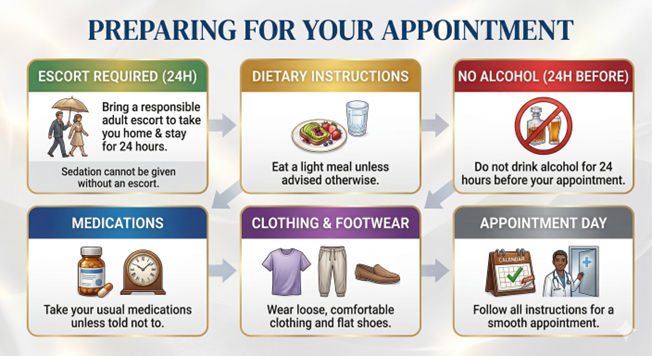
Preparing for your appointment
- You must bring a responsible adult escort to take you home and stay with you for 24 hours. Sedation cannot be given without an escort
- Eat a light meal unless advised otherwise
- Do not drink alcohol for 24 hours before your appointment
- Take your usual medications unless told not to
- Wear loose, comfortable clothing and flat shoes
After sedation
For at least 24 hours (preferably 48 hours), do not:
- Drive
- Drink alcohol
- Use machinery or power tools
- Make important decisions or sign legal documents
- Look after children on your own
You may feel tired for the rest of the day.
Pain and recovery
- Have simple pain relief at home (such as paracetamol or ibuprofen)
- Take pain relief before the numbness wears off
- Follow any post-operative instructions given by your surgical team
- Complete any prescribed antibiotics
Key points to remember
- You will be awake but relaxed
- Sedation reduces anxiety, not pain (local anaesthetic is still needed)
- You must have an escort home
- You cannot drive or drink alcohol for 24 hours
For further information, please visit the following link:
https://www.baos.org.uk/wp-content/uploads/2022/06/MF11-English-Normal.pdf
This leaflet provides general information only. It does not replace a discussion with your surgeon.
You will have the opportunity to ask questions and discuss alternatives before giving consent.


