

Leaflet Details
| Title | Expose and Bond (Exposure of Impacted Upper Canine) |
| Department | Oral and Maxillofacial Surgery |
| Author(s) | Youssef Akoush |
| Review Date | March 2026 |
| Next Review | March 2028 |
| Download | A4 Handout PDF |
| Accessibility Options | Click on the Recite Me button to show our accessibility resources |
Patient Information
What is an impacted canine?
The upper canine usually appears between ages 11 and 13. Sometimes it develops in the wrong place and becomes “impacted” - sitting below the gum and not coming into the mouth. Impacted canines can:
- damage neighbouring teeth roots
- push other teeth out of position and affect your smile
- rarely form a cyst around the tooth
Often, we treat impacted canines as part of orthodontic care to save the tooth and align your smile.
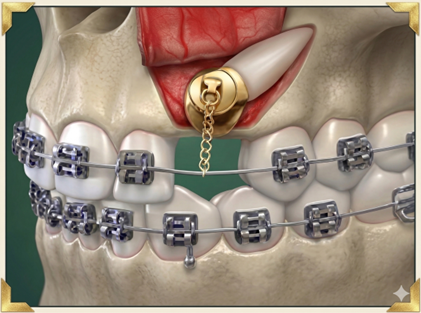
Why an expose-and-bond?
The expose-and-bond procedure reveals the tooth surgically and bonds a small attachment (a bracket or gold chain) so your orthodontist can gently pull the tooth into the correct position using braces. This approach aims to save your natural tooth and achieve a good cosmetic and functional result.
Who will perform the procedure?
An oral and maxillofacial surgeon (with an orthodontist present) will perform the surgery in a day-case setting. The operation may be done under:
- a local anaesthetic (numbing injection) or
- a general anaesthetic (you are asleep and go home the same day)
The exact choice will depend on the tooth position and your preferences.
What happens during the operation?
The gum over the tooth is opened (exposed). Some thin bone may be removed if necessary.
The crown of the tooth is cleaned, and a small attachment (bracket / chain) is bonded to it.
The chain is secured so your orthodontist can later use it to apply gentle traction.
The gum may be repositioned and stitched, and occasionally a protective dressing is placed over the site.
After the operation - what to expect
- Pain: Mild to moderate discomfort is normal. Take simple painkillers such as paracetamol and / or ibuprofen as advised.
- Swelling and bruising: Usually minor and settles in a few days.
- Eating: Soft diet for a few days is recommended.
- Oral hygiene: Keep the area clean. You may be given antiseptic mouthwash and shown how to brush gently around the site.
- Stitches / dressing: If present, stitches are usually dissolvable or removed at your review appointment (typically 1-2 weeks).
- Orthodontic traction: Your orthodontist usually begins gentle pulling on the chain 1-3 weeks after surgery, once initial healing is satisfactory.
Risks and complications
Most people recover without any serious problems. However, as with any surgical procedure, there are some risks.
Common and temporary effects include mild bleeding, swelling and discomfort for a few days.
Less common but important risks include:
- Infection requiring antibiotics
- Damage to adjacent teeth or their roots during exposure
- Bracket or chain failure - the bonded attachment can occasionally come off and require re-bonding
- Root resorption of neighbouring teeth (rare)
- Failure of the impacted tooth to move adequately (for example, if the tooth is ankylosed/fused to bone) - in some cases extraction may be needed
Alternatives to this treatment
- Monitoring only (watchful waiting) if the tooth is unlikely to cause harm
- Extraction of the impacted canine and prosthetic replacement (bridge / implant) or orthodontic space closure
Your surgeon and orthodontist will discuss the best option for you.
Follow-up
You will have a review appointment with the surgeon or orthodontist about 1–2 weeks after surgery. Your orthodontist will plan the timing and force of traction to bring the tooth into the arch. Total treatment time varies - often several months of orthodontic treatment are needed after exposure.
For further information, please visit the following link:
https://www.baos.org.uk/wp-content/uploads/2019/03/Exposing-Unerupted-canines-final.pdf
This leaflet gives general information only and does not replace the chance to ask questions. You will have a face-to-face discussion with your surgeon (and orthodontist where relevant) to explain the procedure, risks and alternatives before you give consent.


