

Leaflet Details
| Title | Oral Biopsy under Local Anaesthetic |
| Department | Oral and Maxillofacial Surgery |
| Author(s) | Youssef Akoush |
| Review Date | March 2026 |
| Next Review | March 2028 |
| Download | A4 Handout PDF |
| Accessibility Options | Click on the Recite Me button to show our accessibility resources |
Patient Information
What is an oral biopsy?
An oral biopsy is a simple procedure where a small piece of tissue is taken from the inside of your mouth so it can be examined under a microscope. This helps your specialist understand what is causing a change such as a lump, ulcer, sore area, or a red or white patch.
Why it helps: the result can reassure you if the tissue is normal or help your clinician decide the most appropriate treatment or follow‑up.
Why do I need one?
Your clinician may recommend a biopsy if:
- an area in your mouth looks unusual
- a sore or ulcer has not healed
- there is a lump or swelling
- you have ongoing pain or discomfort
A biopsy is often the most accurate way to find the cause.
Are there alternatives?
Other tests, such as blood tests or scans, can sometimes give useful information, but they cannot usually provide a definite diagnosis. A biopsy gives the most reliable answer.
If you choose not to have the procedure, your clinician may not be able to confirm the cause of the problem.
What happens on the day?
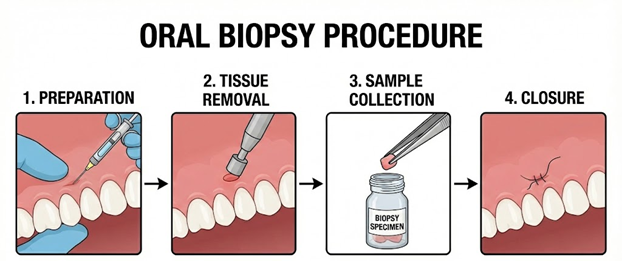
- The procedure is usually carried out in the clinic.
- Local anaesthetic is injected to numb the area. This takes a few minutes to work.
- Once numb, the procedure should be painless, although you may feel pressure.
- A small piece of tissue is removed using fine instruments.
- The area is usually closed with dissolving stitches, which disappear on their own in around 1-2 weeks.
The procedure usually takes about 15 minutes.
What are the risks?
Oral biopsy is a common and generally safe procedure. Most people recover without any serious problems.
Common and temporary effects include mild bleeding on the day of the procedure, discomfort and slight swelling. These usually settle within a few days.
Less common but important risks include:
- Infection
- Prolonged bleeding
- Temporary altered sensation in the area
Your individual risk may be higher if you smoke or have conditions such as diabetes or heart disease.
Getting your results
The tissue sample is sent to the laboratory. Results are usually available within a few weeks.
You will be told how and when you will receive your results, either at a follow‑up appointment or by letter / telephone, depending on your situation.
For further information, please visit the following link:
https://www.baos.org.uk/wp-content/uploads/2022/06/MF10-English-Normal-4.pdf
This leaflet provides general information only. It does not replace a discussion with your surgeon. You will have the opportunity to ask questions and discuss alternatives before giving consent.


