

Leaflet Details
| Title | Oral Lichen Planus (OLP) |
| Department | Oral and Maxillofacial Surgery |
| Author(s) | Youssef Akoush |
| Review Date | March 2026 |
| Next Review | March 2028 |
| Download | A4 Handout PDF |
| Accessibility Options | Click on the Recite Me button to show our accessibility resources |
Patient Information
What is oral lichen planus?
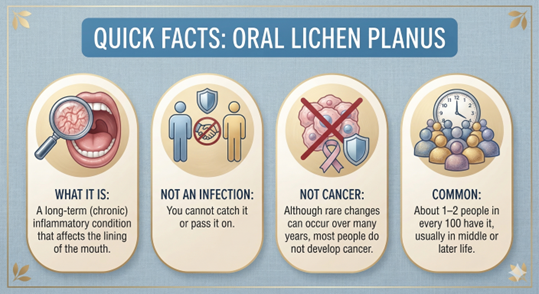
Oral lichen planus (often shortened to OLP) is a long‑term inflammatory condition that affects the lining of the mouth. It is caused by the body’s immune system being slightly over‑active in the mouth. It is not an infection and not cancer.
OLP is relatively common, affecting around 1-2 in every 100 people. It most often develops in middle or later life and is slightly more common in women.
Although there is no permanent cure, symptoms can usually be well controlled with treatment and regular review.
What does oral lichen planus look like?
OLP can appear in several ways and often affects both sides of the mouth in a similar pattern:
- White, lace‑like lines or patches (the most common type)
- Red areas that may feel sore or sensitive
- Ulcers or erosions, which can be painful
- Less commonly, blistering
Areas most often affected are: Inside of the cheeks, Sides of the tongue, Gums, Roof of the mouth.
What oral lichen planus is NOT
- It is not cancer
- It is not contagious - you cannot catch it or pass it on
- It is not inherited
- It is not caused by poor oral hygiene.
What symptoms might I notice?
Many people with OLP have no pain at all, especially with white patches.
If symptoms do occur, they may include:
- Soreness or burning in the mouth
- Discomfort when eating spicy, acidic or hot foods
- Sensitivity to toothpaste or mouthwashes
- Bleeding or ulceration (less common)
Symptoms often come and go over time.
What causes oral lichen planus?
In most people, the exact cause is unknown. OLP is thought to be related to a mild change in the way the immune system behaves in the mouth.
Sometimes OLP‑like changes can be triggered by:
- Certain medications (for example some blood pressure or diabetic medicines)
- Dental materials (rare)
- Stress, which may worsen symptoms
Most people with OLP are otherwise healthy.
How is oral lichen planus diagnosed?
A specialist can often diagnose OLP by examining your mouth.
Sometimes a biopsy is needed to confirm the diagnosis or to rule out other conditions. This involves removing a very small piece of tissue under local anaesthetic. The area usually heals within 1-2 weeks.
Treatment - when and how?
Treatment is only needed if OLP is causing discomfort or pain.
Common treatments include:
Steroid treatments applied to the mouth
These reduce inflammation and help control symptoms. They may be prescribed as:
- Ointments or gels applied directly to sore areas
- Mouthwashes made from dissolvable tablets
- Inhaler sprays used inside the mouth (not breathed in)
Tablet treatment: Very rarely needed, and only for severe cases, under specialist supervision.
Does oral lichen planus go away?
OLP is usually a long‑term condition. Many people continue to have white patches for years.
Treatment aims to:
- Reduce pain and soreness
- Keep the mouth comfortable
- Monitor for any changes
Symptoms often improve significantly with the right treatment.
Is there a cancer risk?
A small number of people with long‑standing oral lichen planus may develop mouth cancer over time (estimated at around 1-3%).
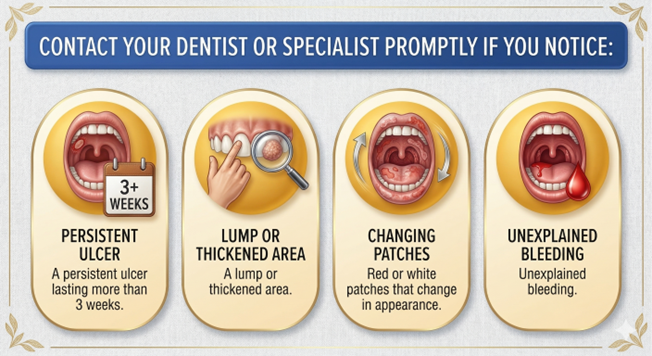
For this reason, regular review is important. Most people with OLP never develop cancer, and monitoring allows early detection of any concerning changes.
What can I do to help myself?
- Do not smoke
- Keep alcohol intake within recommended limits
- Maintain good oral hygiene using a soft toothbrush
- Avoid foods that trigger soreness (for example spicy or acidic foods)
- Attend regular dental check‑ups
- Use any prescribed medication exactly as advised
For further information, please visit the following link:
https://bisom.org.uk/wp-content/uploads/2020/02/OLP-PIL-October-2019.pdf
This leaflet provides general information only. It does not replace a discussion with your surgeon. You will have the opportunity to ask questions and discuss alternatives before giving consent.


