

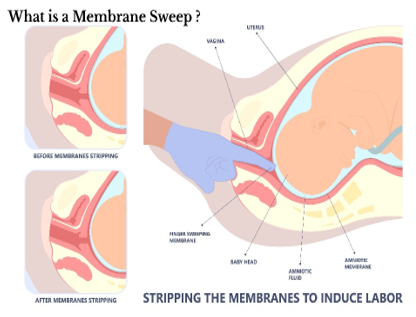
Membrane Sweep: A membrane sweep (sometimes called a stretch and sweep) involves a midwife or doctor inserting one or two fingers into the neck of the womb (the cervix) and using a continuous circular sweeping motion to free the membrane (or bag of waters) from the lower part of the uterus (womb).
Leaflet Details
| Title | Membrane Sweep |
| Department | Maternity |
| Author(s) | Dr Olakite Bolaji, Dr Rakesh Thing, Abi Le Bas, N. Izuwah-Njoku |
| Review Date | December 2023 |
| Next Review | December 2025 |
| Download | A5 Booklet PDF |
| Accessibility Options | Click on the Recite Me button to show our accessibility resources |
Patient Information
What is a membrane sweep?
A membrane sweep (sometimes called a stretch and sweep) involves a midwife or doctor inserting one or two fingers into the neck of the womb (the cervix) and using a continuous circular sweeping motion to free the membrane (or bag of waters) from the lower part of the uterus (womb).
It may be carried out at home, during an antenatal appointment at your GP surgery or in hospital.
When can I have a membrane sweep?
At antenatal visits from 39+0 weeks, your midwife or doctor might discuss with you if you would like to have a membrane sweep, and if so, obtain verbal consent from you to carry out a membrane sweep.
Sometimes, your doctor might offer or recommend a membrane sweep from 37 weeks onwards if you are going to have induction for other reasons such as diabetes, high blood pressure or small for gestational age baby.
If the neck of the womb is closed, a membrane sweep will not be possible. If this happens, your doctor or midwife may offer you a sweep at a later date with your consent.
Why would I be offered a membrane sweep?
The benefit of a membrane sweep is that it may reduce the chance that you will need to have your labour induced by other methods as it may help your body to go into labour. During a membrane sweep, a natural substance called prostaglandin, that is involved in starting labour is released. If the membrane sweep is successful, you will usually go into labour within 48 hours.
Your midwife or doctor might discuss with you whether you would like to have additional membrane sweeping if labour does not start spontaneously following the first sweep.
What are the risks of a membrane sweep?
There are no known significant risks to having a membrane sweep. However, pain, discomfort, vaginal bleeding and/or tightening of the womb are possible following the procedure. All of these are normal and will not cause any harm to you or your baby.
A membrane sweep does not increase the chance of your baby getting an infection.
There is a possibility during the membrane sweep, the waters may be broken. This is not harmful for you or your baby. If this were to happen, we would either arrange induction of labour or wait for labour to start over the next 24 hours after a detailed discussion with you.
Please see the section on what happens if my waters break on page 8 of this leaflet.
Does it hurt?
A membrane sweep could be compared to a vaginal / internal examination or smear test but could be considerably more uncomfortable especially when the neck of the womb (the cervix) is only slightly open or lying far behind the baby’s head. The midwife or doctor will use some lubricating gel to help reduce the discomfort. Should you find the procedure very uncomfortable or painful, you can ask your midwife or doctor to stop the procedure at any time.
Can I choose not to have a membrane sweep?
If you decide not to have a membrane sweep, this is not a problem as it is your choice. Whether you have decided to have a membrane sweep or not, you will always be offered a date to have your labour induced (labour started off).
How successful is a membrane sweep?
Research has shown a small increase in the chances of labour starting within 48 hours of having a membrane sweep and this may reduce the need for other methods of induction of labour.
A recent review of the evidence has shown that:
- 6 out of 10 women went into spontaneous labour without a membrane sweep (598 women in 1000).
- Just over 7 out of 10 women went into spontaneous labour with a membrane sweep (723 in 1000).
- 3 out of 10 women without a membrane sweep had their labour induced (313 women in 1000).
- 2 out of 10 women with a membrane sweep had their labour induced (228 women in 1000).
- Approximately 2 out of 10 women without a membrane sweep delivered by caesarean section (155 women in 1000)
- Approximately 2 out 10 women delivered by caesarean section with a membrane (165 women in 1000)
- 7 out of 10 women had a vaginal delivery with a membrane sweep (733 women in 1000)
- 7 out of 10 women had a vaginal delivery without a sweep (711 women in 1000)
- There was no difference in serious maternal or neonatal complication or death between the two groups.
Reference: Finucane et al. 2020
After having a membrane sweep
After your membrane sweep you should wear a sanitary pad and you can go home and wait for labour to start.
Vaginal discharge
You may experience a ‘show’ after your membrane sweep; this is a mucous discharge from the vagina which may contain some blood. If you have any fresh bleeding from your vagina or have any other concerns after the membrane sweep, please call the Midwife Surrey Advice Line 03001235473.
Discomfort
It is likely that you will get some period-like tummy type pain also called tightenings over the next 24 hours. You can take some Paracetamol (2 tablets of 500mg) for this, but do not take more than the recommended dose. You might like to have a warm bath too, which can also help.
If the tightenings become regular and more painful, please contact the Midwife line above as you may be going into labour.
What happens if my waters break?
Sometimes your waters may break before labour starts. This is known as pre-labour rupture of membranes. If you think your waters have broken, it is important you discuss this with a midwife.
Please call the Midwife Surrey Advice Line 03001235473 if you have any leakage of water or fluid from your vagina.
If your waters have broken but you have not gone into labour, you will be offered the choice of either:
- Immediate induction of labour in keeping with national guideline. We may not always be able offer this option if the unit is extremely busy and we think proceeding with this option may put you or your baby at risk. We will, however, do our best to support your decision. Immediate induction may also be necessary due to concerns for your own health or that of your baby. If this is not your preferred option, we will explain why immediate induction is necessary and come to a mutual agreement with you.
- A ‘wait and see’ approach to await the onset of natural labour if all remains well. 6 out of 10 pregnant people whose waters break before labour starts will go into labour naturally within 24 hours of the waters breaking.
Contraindications
We would not recommend a membrane sweep under the following conditions:
- There is a confirmed placenta praevia (low lying placenta).
- The vertex (leading part of the baby) is not in the pelvis.
- There has been vaginal bleeding in the last 6 weeks of the planned membrane sweep unless this has been discussed with your obstetrician
- If the baby is not in a head down position (e.g., breech -bottom coming first or transverse lie)
Pregnant people with a diagnosis of Group B streptococcus infection (GBS) with intact membranes can safely have a membrane sweep.
For scientific evidence on membrane sweep, please visit:
https://www.cochrane.org/CD000451/PREG_membrane-sweeping-induction-labour


