

In this section, we have leaflets for the Clinical Neurophysiology department. Please only read the materials on the advice of your clinician.
The Recite Me accessibility tools can be used if you need assistance.
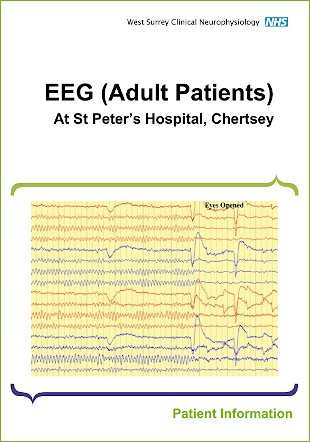
EEG Adult
For patients at St Peter's Hospital.
EEG stands for Electroencephalogram, a recording of the electrical signals produced by the brain. In the media it is sometimes referred to as recording brainwaves.
The EEG gives information about the brain that is useful to your doctor in making a diagnosis in several different conditions. It is the only test that can produce this sort of information, but your doctor may also want to get information from other tests.
EEG Child
For patients at St Peter's Hospital.
An introduction for parents, guardians, and older children.
EEG stands for Electroencephalogram, a recording of the electrical signals produced by the brain. In the media it is sometimes referred to as recording brainwaves. The EEG gives information about the brain that is useful to the doctor in making a diagnosis in several different conditions. It is the only test that can produce this sort of information, but your doctor may also want to get information from other tests.
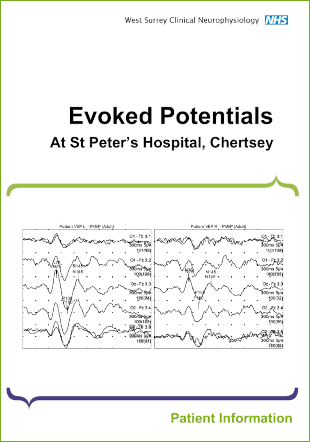
Evoked Potentials
For patients at St Peter's Hospital.
These are a group of diagnostic tests which record the electrical signals produced naturally by the brain following repeated stimulation.
- Visual Evoked Potentials (Eyes)
- Electroretinogram (Eyes)
- Auditory Evoked Potentials (Ears)
- Somato-sensory Evoked Potentials (Arms and Legs)
Your doctor may ask us to test one or more of these.
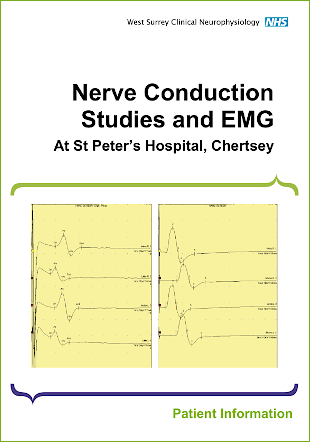
Nerve Conduction Studies and EMG (St Peter's)
For patients at St Peter's Hospital.
Nerve conduction studies (NCS) are recordings made of the electrical activity from nerves and muscles in response to stimulation.
EMG stands for Electromyogram, a recording of the electrical signals produced naturally by muscles.
These two kinds of study may be used together or separately, and we often just call them EMG. They give information about nerves, muscles and the connections between them. The information may be useful to your doctor in many different types of condition. Your doctor may have to combine this information with other types of information to make a diagnosis.
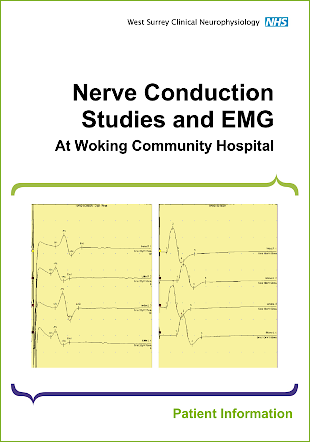
Nerve Conduction Studies and EMG (Woking)
For patients at Woking Community Hospital.
Nerve conduction studies (NCS) are recordings made of the electrical activity from nerves and muscles in response to stimulation.
EMG stands for Electromyogram, a recording of the electrical signals produced naturally by muscles.
These two kinds of study may be used together or separately, and we often just call them EMG. They give information about nerves, muscles and the connections between them. The information may be useful to your doctor in many different types of condition. Your doctor may have to combine this information with other types of information to make a diagnosis.
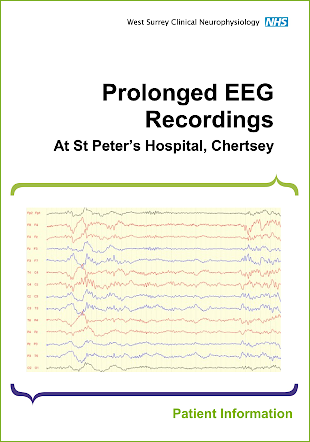
Prolonged EEG Recording
For patients at St Peter's Hospital.
EEG stands for Electroencephalogram, a recording of the electrical signals produced by the brain. In the media it is sometimes referred to as recording brainwaves.
The EEG gives information about the brain that is useful to your doctor in making a diagnosis in several different conditions. It is the only test that can produce this sort of information, but your doctor may also want to get information from other tests.


