

Leaflet Details
| Title | Outpatient Management of Bartholin’s Abscess or Cyst with Word Catheter |
| Department | Gynaecology |
| Author(s) | Miss Izuwah-Njoku, Dr Rinaya Mohammed |
| Review Date | April 2024 |
| Next Review | April 2027 |
| Download | A5 Booklet PDF |
| Accessibility Options | Click on the Recite Me button to show our accessibility resources |
Patient Information
Introduction
This leaflet is aims to help women with a cyst or abscess of the Bartholin's gland to gain an understanding of the condition and treatments available. If there is anything you do not understand or if you have any questions, please ask the clinic nurse or doctor.
What is a Bartholin's gland?
The Bartholin's glands are located on both sides of the vaginal opening. Under normal conditions, they are not noticeable. These glands secrete a fluid (through tiny openings called ducts) that keeps the vagina moist.
What is a Bartholin's cyst?
A cyst forms when the ducts leading to the gland become blocked. The reason this occurs is not clear, but it may be due to infection. There is little you can do to prevent it.
If the duct becomes blocked, the gland becomes bigger as fluid secreted by the gland becomes trapped inside and you will become aware of a lump inside the vagina. This may become infected. If this happens, the skin around them may become red, hot, swollen, and unbearable tender.
This may progress to form an abscess-a collection of pus (thick creamy fluid) within the Bartholin's gland. The gland may pop and ooze with pus, or if it might not. The cyst can vary in size from pea size to a golf ball or bigger. In some people, the cyst may intermittently get bigger and resolve again with little symptoms.
What is the treatment for the cyst or abscess?
If you have a small cyst that causes no symptoms and does not develop into an abscess, then it may be best to simply leave it alone. If an abscess forms, it will almost always need treatment. Treatment will be a course of antibiotics or if necessary, an operation to drain the abscess.
Antibiotics: A course of antibiotics has a good chance of curing an infected gland or abscess. However, as a rule, the more pus that forms, the larger the abscess and the less chance that antibiotics alone will be sufficient to clear the abscess and surgery may be required.
Surgery: The main aim of the operation is to drain any fluid or pus. This relieves the symptoms and may also minimise the chance of the problem recurring. A simple incision and drainage can be performed but this has a higher recurrence rate. An artificial draining channel or pouch can be made using a process called marsupialisation after the abscess has been drained (the opening or pouch is left for any fluid to drain out thereby reducing the chance or re-occurrence) and is carried out under general anaesthetic (you are put to sleep).
The procedure may also be performed under a local anaesthetic (you are awake and the area is numbed) using the Word catheter and this is described below. A course of antibiotics may be prescribed if pus has been drained.
Your doctor will discuss the most appropriate treatment option with you and will explain the benefits and risks.
The word catheter
An alternative treatment for Bartholin's abscess involves putting local anaesthetic over the area of the enlarged gland to numb it so it is not painful. A small cut is made in the inner portion of the vagina. This allows the fluid or abscess to be drained out. The doctor may flush the cavity with some sterile fluid.
Thereafter, the Word catheter - a small rubber tube (word catheter), is put in through the opening that has been created. The plastic tubing has a little balloon at the tip and this is filled with about 3mls of sterile fluid. The balloon helps to keep the tube in place. The lower end of the tube is tucked into the vagina. The tube is left in place for a few weeks.
During this time, the tube leads to formation of a new draining tube (duct) through which the gland can drain once the Word catheter is removed.
Most women find the procedure acceptable, and you can still be able to carry on with your normal activities afterwards.
The Word catheter should not interfere with intercourse though we will suggest using sanitary pads instead of tampons if your period starts during treatment.
The benefits of this form of treatment include avoiding using general anaesthetic (GA) as well avoiding the risk of GA, avoiding post-operative vomiting, shorter hospital stay, less interference with normal activities, earlier return to normal activities, no need for an escort from hospital, no need to starve before the operation and it can be performed as an emergency to relive acute symptoms without waiting for a theatre space.
The success rate of this form of treatment (word catheter) and treatment under general anaesthetic, recurrence and complications are similar. The disadvantage of this treatment is that the local anaesthetic will numb the area, but you will be awake and be aware of sensation like touch and may experience some discomfort. Should this happen, we could either give more local anaesthetic or abandon the procedure should you want us to.
We will give you a further appointment to return to the hospital to have the word catheter removed in a few weeks. This time is required to allow a new duct (channel) to help drain the Bartholin's gland.
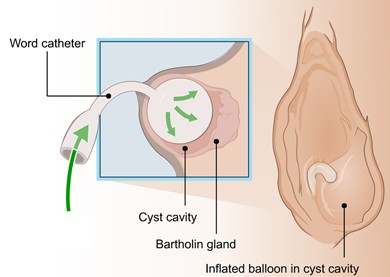
This procedure is fairly well tolerated and is commonly in other hospitals in the United Kingdom.
How successful is surgery for treating a Bartholin's cyst or abscess?
Surgery is usually quite successful in 97% cases. In few cases, the problem may recur despite having this treatment. This treatment has a higher success rate when compared to a simple cut (incision and drainage) to drain a Bartholin's cyst or abscess because it creates a new duct (channel) for the gland to drain thereby reducing the chance of the problem re-occurring in the future. As with all operations, there is a small chance of problems arising e.g. infection of the wound occurs in a small number of cases following treatment.
Are there any other alternative treatments different from the ones already discussed?
Some people recommend that sitting in a warm bath for 10-20minutes, three to four times a day, may encourage the Bartholin's cyst to burst naturally. It is not clear how well this may work. However, it is always best to see your doctor if you think an abscess is developing.
Sometimes the entire gland is removed by surgical operation. This is considered a last resort but may be advised if you have several recurrences of the Bartholin's cyst or abscess.
What to expect after the operation
If you decide to go ahead with the procedure, drainage of a Bartholin's abscess using the Word Catheter, inform the doctor.
As the procedure involves a very sensitive area of the body, be aware of the following:
- We place 3mls of fluid in the tube and most women are comfortable with this. If you experience worsening pain, you should attend the accident and emergency and we may discuss the option of removing a small amount of fluid from the Word catheter.
- You will need to rest for a couple of days after you leave hospital.
- You can bath or shower but avoid bubble bath, oils, or talcum powder while the wound is healing.
- Avoid sexual intercourse until there is no discharge and you are pain free.
- Take pain killers if you need them, following the dosage advice on the packet.
- Avoid tight-fitting clothes, e.g. jeans wear or underwear until pain free.
- We will inform you on when to return to have the word catheter removed.
- Should the catheter fall out on its own, don't be alarmed. This is usually a sign a new duct (channel) has formed which is the aim of the procedure. Please contact us if you have any urgent concerns or the word catheter falls out. If the word catheter falls out, we will cancel your follow up to remove the catheter.
- Please contact us using the number 01932 723984 (0900-1700 hours). Please note, the phone will be answered by the health care assistant (HCA) or receptionist working in Blanche Heriot Unit between 0900 - 1700 (weekdays only excluding bank holidays) who will take your personal details, contact number and the details of your enquiry. The receptionist or HCA will be unable to give you any clinical advice. Your details and enquiry will be given to the Gynecology on call team doctors, who will contact you to discuss your enquiry.
- We apologize in advance if there is a delay in the on-call team contacting you. This will usually be because the on-call team are managing other emergencies.
- You may also contact your GP should you have any questions.
Where can I get more information?
NHS Website:
https://www.nhs.uk/conditions/bartholins-cyst/
NICE:
https://www.nice.org.uk/
For more information about the Trust, visit our website at
https://www.ashfordstpeters.nhs.uk/
Contact number: 01932 723984 from 0900-1700 (Our Blanche Heriot team will liaise with the on-call team)


