

In this section, we have leaflets for the Gynaecology department. Please only read the materials on the advice of your clinician.
The Recite Me accessibility tools can be used if you need assistance.
Bartholin’s Abscess or Cyst with Word Catheter
This leaflet is aims to help women with a cyst or abscess of the Bartholin's gland to gain an understanding of the condition and treatments available. If there is anything you do not understand or if you have any questions, please ask the clinic nurse or doctor.
The Bartholin's glands are located on both sides of the vaginal opening. Under normal conditions, they are not noticeable. These glands secrete a fluid (through tiny openings called ducts) that keeps the vagina moist.
BMI and Infertility
Your weight, whether too low or too high, can affect your chance of getting pregnant, which is why a healthy weight is important. Being underweight or overweight can also reduce the efficacy of fertility treatments and can increase the risk of pregnancy complications.
Cervical Polyp Removal
A cervical polyp is a small piece of tissue, usually on a stalk, that grows on the cervix (neck of the womb). These polyps could be broad based, when it does not have a stalk but sits on the cervix. Polyps often cause no symptoms at all, but they can cause irregular vaginal bleeding or increased vaginal discharge. It can also make it more difficult to get a good smear sample in the future.
Colposcopy and Conservative Management of CIN2
This leaflet gives you information about CIN2 (Cervical Intraepithelial Neoplasia Grade 2), which means there are some abnormal cells on your cervix.
CIN means there are abnormal cells on your cervix. CIN is caused by the human papillomavirus (HPV). CIN is graded from 1 to 3. CIN1 means mildly abnormal cells, CIN2 means moderately abnormal cells and CIN3 means severely abnormal cells.
Colposcopy and Lletz Biopsy
LLETZ stands for Large Loop Excision of the Transformation Zone.
A LLETZ treatment removes abnormal cells from your cervix. The tissue that is removed is tested in a laboratory. This helps us confirm the diagnosis and plan any follow-up care you may need.
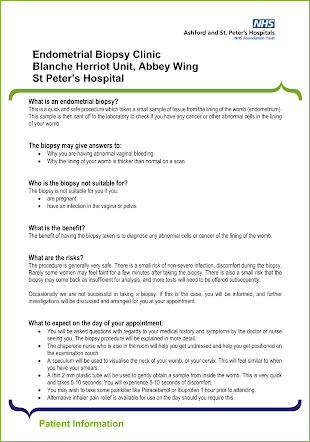
Endometrial Biopsy Clinic
This is a quick and safe procedure which takes a small sample of tissue from the lining of the womb (endometrium). This sample is then sent off to the laboratory to check if you have any cancer or other abnormal cells in the lining of your womb.
Endometriosis
Endometriosis is where tissue similar to the lining of the womb grows outside the womb, on the lining of inside of pelvis, on ovaries, bowel and many other organs. The cause is not known. Research shows that on average it takes 7 years from the time of onset of pain to diagnosis.
Sometimes there are no symptoms, and it is found by chance when a woman is having an operation. However, for many women it can be a very painful condition, and it is diagnosed when these symptoms are investigated. In other cases, it is identified in women who are having difficulty getting pregnant.
Fertility Welcome Pack
The Fertility unit is a specialist gynaecology service with clinics and theatres located at both St Peter’s Hospital and Ashford Hospital. It provides a one-stop comprehensive assessment for couples who have difficulties conceiving and offers individualised treatments according to their needs.
Follicle Tracking Scans
During ovulation the follicle ruptures, sometimes causing some lower abdominal discomfort and the egg escapes and passes into the Fallopian tube where it meets sperm. After ovulation the follicle becomes the Corpus Luteum which produces another hormone called Progesterone which causes the lining of the womb to be receptive to an embryo. All evidence of the follicle and corpus luteum normally disappears by cycle day 28.
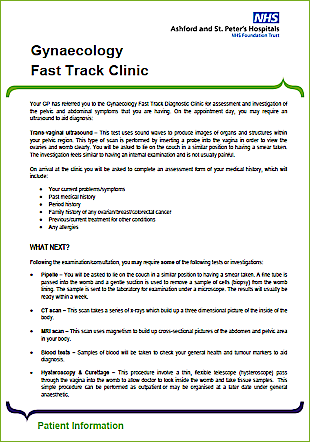
Gynaecology-Oncology Fast Track Clinic
Your GP has referred you to the Gynaecology Fast Track Diagnostic Clinic for assessment and investigation of the pelvic and abdominal symptoms that you are having. On the appointment day, you may require an ultrasound to aid diagnosis:
Trans-vaginal ultrasound – This test uses sound waves to produce images of organs and structures within your pelvic region. This type of scan is performed by inserting a probe into the vagina in order to view the ovaries and womb clearly. You will be asked to lie on the couch in a similar position to having a smear taken.
The investigation feels similar to having an internal examination and is not usually painful.
How to Recover from an Abdominal Myomectomy
This information leaflet is for those who have or are about to have an abdominal myomectomy. This is an operation to remove fibroids located in the womb either through an incision on the lower abdomen (bikini line) or an incision in the midline which may stop at the umbilicus (belly button) or go above the umbilicus depending on how big the fibroids are. We look forward to welcoming you to Ashford and St Peter’s Hospitals for your operation.
How to Recover Quickly from Laparoscopic and Robotic-Assisted Surgery
Laparoscopic and Robotic-Assisted Surgery are both forms of minimally invasive surgery laparoscopy (also known as keyhole surgery) offered at Ashford and St Peter’s Hospitals under a general anaesthetic. Usually, three to five small cuts (half to one centimetre in length) are made in the abdomen, allowing your surgeon to insert a small telescope so that they can see inside your abdomen and your reproductive organs directly. Your abdomen will be filled with gas to create space and provide a clear picture and if necessary, to treat any problems as agreed with you before your operation. Before you agree to surgery and sign a consent form, your surgeon will discuss what is planned. This is called informed consent.
Laparoscopic Procedures for the Treatment of Endometriosis of Pelvic Nerves and Pelvic Nerve Entrapment
This leaflet aims to help you understand how laparoscopic procedures on pelvic nerves are performed and what potential complications of such surgery are. Please read this carefully and consider all the information contained in this leaflet and ask any questions that you may have from us before making your decision.
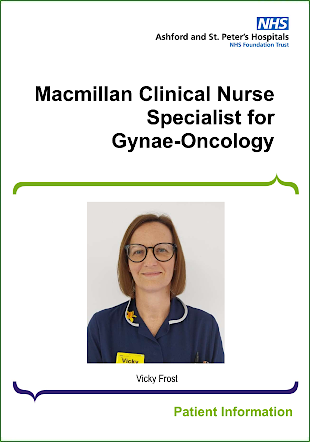
Macmillan Clinical Nurse Specialist for Gynae-Oncology
Receiving a cancer diagnosis is a life changing event and you and your family may experience a wide range of emotions and have a lot of questions and concerns throughout your cancer journey.
Your Clinical Nurse Specialist (CNS) is available to provide ongoing support from the initial investigations leading to diagnosis, throughout your treatment and on to living with and beyond cancer.
Outpatient Hysteroscopy
Outpatient hysteroscopy (OPH) is a procedure which allows us to look inside the womb. During the procedure a fine telescope called a hysteroscope is guided through the vagina and neck of the womb into the womb.
Ovulation Induction with Clomiphene Treatment
Clomiphene is an anti-oestrogen which suppresses the amount of naturally circulating estrogen and this will cause the brain to produce more FSH hormone which causes the ovaries to develop a follicle with an egg inside.
Ovulation Induction with Letrozole Treatment
Letrozole belongs to a class of drugs called aromatase inhibitors and it is a fertility drug to stimulate ovulation. Letrozole works by lowering the oestrogen levels which in turn increases the hormone FSH which causes the ovaries to develop a follicle with an egg inside.
Penthrox Used for Pain Relief
Penthrox is a medication used to relieve pain during gynaecology procedures or injuries. It contains a substance called methoxyflurane, which is inhaled through a special device.
When inhaled, Penthrox numbs the nerves that transmit pain signals to the brain. This helps to reduce the sensation of pain quickly and effectively.
Personalised Stratified Follow Up After Treatment for Primary Endometrial Cancer
The personalised stratified follow up service has been specifically designed to support you when you have completed your treatment. It is a type of follow up where you, the patient, are in control. Instead of being offered regular visits, you can make an appointment to see us if you have worries or concerns following your consultation. It is based on evidence showing that symptoms and concerns are addressed more quickly if patients report them as and when they occur, rather than waiting for a routine appointment.
Personalised Stratified Follow Up After Treatment for Primary Ovarian Cancer
The personalised stratified follow-up service has been specifically designed to support you when you have completed your treatment. It is a type of follow-up where you, the patient, are in control. Instead of being offered regular visits, you can make an appointment to see us if you have worries or concerns following your consultation. It is based on evidence showing that symptoms and concerns are addressed more quickly if patients report them as and when they occur, rather than waiting for a routine appointment.
Pre-Operative Bowel Preparation for Gynaecological Laparoscopic Surgery
Prior to your admission for laparoscopic surgery, we would like to ensure that your bowel is completely empty as this makes surgery easier to perform and reduces the risk of bowel injury to you. In the unlikely event of this occurring, it makes the management much easier as there is much less risk of contamination. It does, however, mean that you will have to go on a special diet for four days prior to your surgery and take strong laxatives. The laxatives will be given to you at your Preadmission assessment appointment together with instructions.
Preterm Birth Surveillance Clinic
The preterm birth clinic aims to provide extra care for women who may have a higher risk of having a baby born too early. The clinic is led by a Consultant Obstetrician.
Removal of Polyp / Fibroid using MyoSure Device
This is a procedure performed using a small telescope (hysteroscope) with a camera and light attached to it which is passed through the neck of your womb (cervix) to the inside of your womb (uterus). This enables visualisation as well as removal of polyps and fibroids growing inside the womb cavity using the MyoSure device.
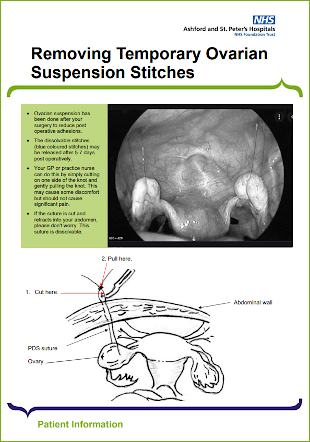
Removing Temporary Ovarian Suspension Stitches
Ovarian suspension has been done after your surgery to reduce post operative adhesions. The dissolvable stitches (blue coloured stitches) may be released after 5-7 days post operatively.
Reviewing Your Cervical Screening History
You may have many questions after being diagnosed with cervical cancer. You may be worried about your treatment and what will happen next. We are here to support you.
TCRF (Transcervical Resection of Fibroids)
TCRF is a procedure in which the fibroids protruding into the lining of the womb (uterus) are removed or shaved off to make the womb lining as normal as possible (also called resection) using a wire loop. The operation is performed using a hysteroscope, an instrument like a telescope which allows the surgeon to see the inside the womb. Special instruments can then be passed along the hysteroscope so that surgical procedures can be carried out. When the hysteroscope carries a wire loop it is called a resectoscope. Myosure, a device with an integrated device can also be used for resection.
Termination of Pregnancy
Finding out that you are pregnant can be a shock. This leaflet is intended for people considering termination of pregnancy.
Treatment Options for Ovarian Endometriomas
This information is for you if you wish to know more about endometriomas. It may also be helpful if you are the partner or relative of someone with endometriosis.
Vaginal Dryness
Vaginal dryness, often called atrophic vaginitis, is a common condition that affects many women, particularly after menopause. Nowadays, the term genitourinary syndrome of menopause (GSM) is typically used. GSM describes a group of chronic, progressive, low-oestrogen conditions, which include vaginal dryness, vulvovaginal atrophy, and issues with bladder and urethral function. This leaflet will focus specifically on understanding and managing vaginal dryness.
Vulval Skincare
The purpose of this leaflet is to provide you with information regarding vulval skin care. It provides general advice on good vulval skincare for all girls and women.
Your Road to Recovery - Lap Hysterectomy
This information is for you if you are about to have, or you are recovering from, an open hysterectomy (an operation to remove your uterus (womb) by an incision on your abdomen). You might also find it useful to share this information with your family and friends.
Your Road to Recovery Open Hysterectomy
This information is for you if you are about to have, or you are recovering from, an open hysterectomy (an operation to remove your uterus (womb) by an incision on your abdomen). You might also find it useful to share this information with your family and friends.


