

Leaflet Details
| Title | Cervical Polyp Removal |
| Department | Gynaecology |
| Author(s) | Gynaecology Team |
| Review Date | October 2024 |
| Next Review | October 2027 |
| Download | A5 Booklet PDF |
| Accessibility Options | Click on the Recite Me button to show our accessibility resources |
Patient Information
Introduction
A cervical polyp is a small piece of tissue, usually on a stalk, that grows on the cervix (neck of the womb). These polyps could be broad based, when it does not have a stalk but sits on the cervix. Polyps often cause no symptoms at all, but they can cause irregular vaginal bleeding or increased vaginal discharge. It can also make it more difficult to get a good smear sample in the future
One in ten women will have a polyp in their lifetime but the cause is unknown. They usually continue to grow if they are not treated but they can occasionally reoccur.
They are almost always benign (not cancerous) but a tiny percentage of polyps are abnormal and may develop into cancer if left.
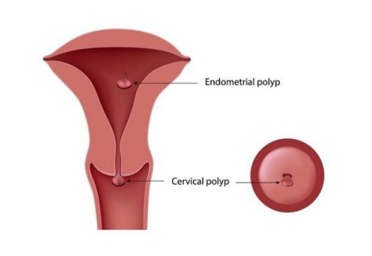
Treatment of cervical polyps
Once polyps have been found, they are easy to remove with a minor procedure. This is usually carried out in the outpatient setting or rarely as a day case operation while you are asleep. The nurse specialist or doctor you see, will talk you through how they plan to remove the polyp. Please feel free to ask further questions during this time if anything is not clear.
Small polyps can be removed very simply by being twisted off the cervix and do not require local anaesthetic. The procedure is quick and a similar experience to having a smear test. Generally, the removal of the polyp cannot be felt but, in some cases, abdominal pain (like period cramps) can be present. The pain should settle down quite quickly.
Larger polyps may require local anaesthetic to numb the cervix and then removal using a heated wire loop. You may experience abdominal cramps during the removal of the polyp, as local anaesthetic cannot prevent these. You may be referred for a hysteroscopy (camera test to assess the lining of the womb) if the base of the polyp appears to be higher in the cervix and cannot easily be removed.
After polyp removal you may be aware of some initial lower abdominal pain for which we recommend over-the-counter painkillers if required. There may also be some discharge or light bleeding that could last for up to two weeks.
Are there any risks of polyp removal?
Heavy bleeding following the polyp removal is rare but if it does not settle as expected then it may be necessary to cauterise any heavy bleeding from the neck of the womb.
Occasionally, you could develop an infection. If this happens, you may experience abdominal pain and develop a smelly discharge from the vagina. If this occurs, please contact your GP surgery for an appointment as your GP will need to prescribe antibiotics for you.
After polyp removal
The following advice aims to prevent infection and optimise healing.
We recommend:
- No sexual intercourse for one week. You can resume once bleeding has stopped.
- No tampons for one week
- No vigorous exercise or swimming for one week
Alternatives to having a cervical polypectomy
You can choose not to have the procedure if you feel you can cope with the symptoms the polyp may be causing (if any). However, the polyp may become bigger and cause you to have abnormal bleeding. Most polyps are benign (not harmful) but very rarely they could contain abnormal cells.
Results
All polyps are sent for histology so that the cells can be analysed under the microscope. We will write to you and your GP with the results. The results can take 6-8 weeks.


